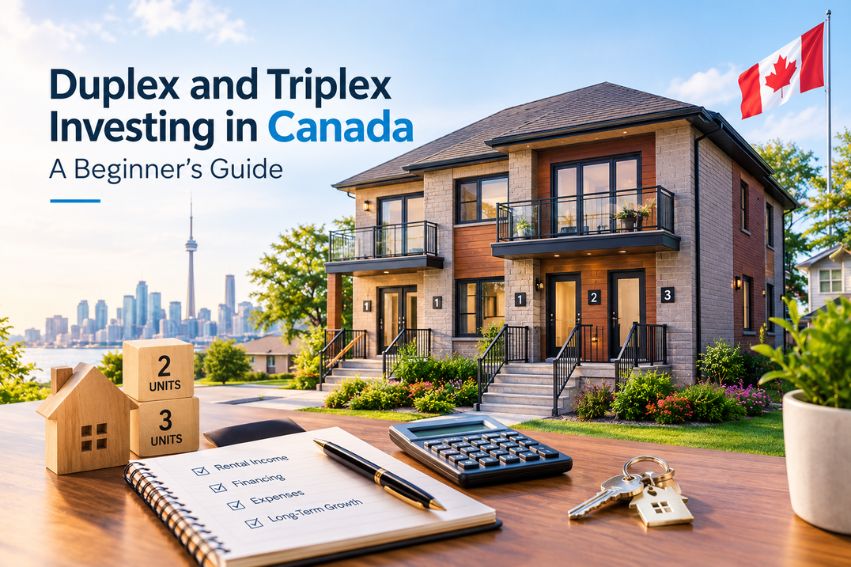
Investing in real estate does not always mean buying a large apartment building or owning multiple properties. For many Canadians, a duplex or triplex can be a practical way to enter the rental property market while building long-term wealth.
These multi-unit residential properties allow investors to earn rental income from two or three separate living units within one property. Some buyers choose to live in one unit and rent out the others, while others purchase the entire property as an investment.
However, successful real estate investing involves more than collecting rent. Understanding financing, property expenses, local rental regulations, and potential risks is essential before making a purchase.
This beginner’s guide explains how duplex and triplex investing works in Canada and what you should consider before getting started.
What Is a Duplex or Triplex?
A duplex is a residential property containing two separate living units, while a triplex contains three. Depending on the building’s design, these units may be arranged side by side, stacked on different floors, or configured as separate apartments within one building.
Each unit may have its own kitchen, bathroom, entrance, and living space. However, the building’s layout and legal status vary by property.
Duplexes and triplexes are common in several Canadian markets, particularly in cities such as Montreal, Quebec City, Toronto, and parts of Ottawa. They can appeal to investors who want to generate rental income without managing a larger apartment complex.
Before purchasing, confirm that every unit is legally recognized and permitted for residential occupancy. A basement apartment or converted space is not automatically a legal rental unit simply because it is currently occupied.
Why Invest in a Duplex or Triplex in Canada?
1. Multiple Rental Income Sources
One of the main advantages of multi-unit properties is the ability to generate rental income from more than one tenant.
For example, a triplex with three rented units can continue producing income from the remaining units if one tenant moves out. This does not eliminate vacancy risk, but it can reduce dependence on a single tenant compared with owning a property that contains only one rental unit.
2. The Opportunity to Live in One Unit
Some investors purchase a duplex or triplex, occupy one apartment, and rent out the remaining units. This approach can combine homeownership with rental income.
The rent collected may help offset mortgage payments and other housing expenses. Buyers must still budget for periods without tenants, repairs, utilities, property taxes, and other ongoing costs.
3. Potential for Long-Term Appreciation
A well-maintained property in a desirable location may increase in value over time. Factors such as population growth, employment opportunities, transportation access, and neighbourhood development can influence demand.
However, property values can also decline. Appreciation is not guaranteed, and investors should ensure the property makes financial sense without relying entirely on future price increases.
4. Greater Control Over the Investment
Owning a small multi-unit property gives investors more direct control over maintenance, tenant selection, rental strategy, and property improvements, subject to applicable laws.
This control also brings responsibility. Owners must maintain safe living conditions, comply with rental regulations, and respond to repair and maintenance issues.
How to Choose the Right Property
The purchase price is only one part of the investment decision. A property’s rental potential, condition, location, and operating expenses can have an even greater effect on its performance.
Location and rental demand: Look for areas with access to employment centres, public transportation, schools, shopping, and other everyday amenities. Research comparable rental listings and local vacancy conditions before estimating potential income.
Property condition: Pay attention to the roof, foundation, plumbing, electrical systems, heating, insulation, and signs of water damage. Older multi-unit properties may require substantial repairs or upgrades.
Legal status and zoning: Verify the approved number of units, municipal zoning, permits, fire-safety requirements, and any restrictions affecting the intended use. Rules differ between municipalities.
Existing tenants and leases: When buying an occupied property, review the rental agreements, payment history, deposits, and applicable tenant protections. Do not assume that purchasing a building gives you the right to change rents or end tenancies freely.
Future maintenance: Consider the likely cost of major repairs and establish a reserve fund. An inexpensive property can become a poor investment if it requires significant unplanned work.
Understanding Mortgage Financing
Financing a duplex or triplex can differ from financing a single-family home. The lender may consider your income, credit history, existing debts, down payment, property condition, and some portion of the expected rental income.
If you plan to live in one of the units, you may qualify for owner-occupied financing, depending on the lender’s requirements and the property’s eligibility.
Under current Canada Mortgage and Housing Corporation (CMHC) purchase-insurance rules, eligible owner-occupied properties with three or four units generally require a minimum 10% equity contribution. For eligible owner-occupied properties with one or two units, the minimum equity requirement follows a different structure. Property-value limits and other conditions apply.
For non-owner-occupied properties, the CMHC Income Property program generally requires at least 20% equity for eligible two-to-four-unit rental properties, with additional eligibility and property-value requirements. These rules are program-specific and may not apply to every financing arrangement.
Review the current requirements directly with your mortgage professional before making an offer.
Remember to budget for the down payment, closing costs, inspections, legal fees, and any immediate repairs. Mortgage qualification should be based on realistic expenses and rental assumptions rather than the expectation that every unit will always be occupied.
How to Calculate Rental Income and Cash Flow
Before purchasing a duplex or triplex, estimate how much income the property could generate and compare it with its expected expenses.
Consider a hypothetical triplex with the following monthly rents:
- Unit 1: $1,800
- Unit 2: $1,700
- Unit 3: $1,600
Total potential monthly rental income: $5,100
This represents $61,200 in potential gross annual rental income if all three units are rented at those rates for the entire year.
However, gross rental income is not the same as profit.
You must account for mortgage interest and principal payments, property taxes, insurance, repairs, maintenance, utilities paid by the owner, vacancy periods, and property management costs.
For example, if operating expenses and an allowance for vacancies average $1,800 per month, the remaining $3,300 would be available toward debt payments and other costs not included in that estimate. The property’s actual cash flow depends on the mortgage payment and any additional expenses.
A useful starting calculation is:
Monthly cash flow = Rental income − Operating expenses − Mortgage payments
Important Risks to Consider
Like any real estate investment, duplex and triplex ownership comes with risks.
Vacancies and missed payments: Even a property with multiple units can experience periods of reduced income. Keep sufficient savings to cover mortgage payments and essential expenses during difficult months.
Unexpected repairs: Heating failures, plumbing problems, roof repairs, or structural issues can require substantial spending. Arrange an inspection and budget for future capital improvements.
Changing financing costs: Mortgage payments may change when a loan renews or when a variable-rate mortgage adjusts. Evaluate whether the investment remains affordable under less favorable financing conditions.
Rental regulations: Landlord and tenant rules vary by province and territory. Rent increases, lease terminations, deposits, repairs, and eviction procedures may be subject to specific legal requirements. Review the rules that apply where the property is located before renting out a unit.
Property management responsibilities: Managing several tenants requires time, organization, and communication. Hiring a property manager can reduce your workload, but the fee must be included in your financial calculations.
Duplex vs. Triplex: Which Is Better for Beginners?
Neither property type is automatically the better investment. The right choice depends on your available budget, financing, preferred location, property condition, and rental demand.
A duplex may have a lower purchase price in some markets and may be easier for a first-time investor to manage. A triplex offers an additional potential rental income source, but it may also involve a higher purchase price, greater operating expenses, and more complex maintenance needs.
Instead of choosing based solely on the number of units, compare the expected net income, required cash investment, property condition, and potential risks of each property.